The vulnerability of open perimeters
Why software security fails without hardened physical hardware, and what changes when trust is anchored in silicon.

Most security programmes are written in the language of software: patches, permissions, penetration tests. That language describes only the top of the stack. Below it sit firmware, boot code, and silicon that few organisations can inspect and almost none can verify.
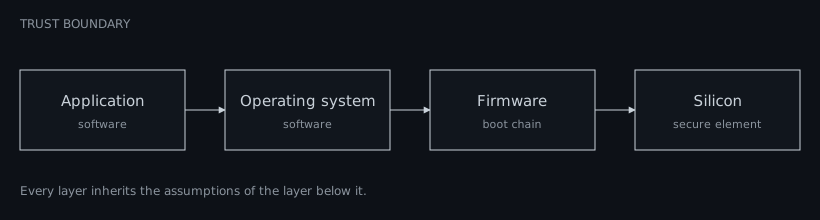
Trust is inherited
Every layer in a system assumes that the layer beneath it behaves as documented. A hardened application on an unverified operating system is protected only as far as that system is honest. The same holds one level down, at firmware, and again at the chip.
You can’t trust code that you did not totally create yourself.
— Ken Thompson, Reflections on Trusting Trust (Turing Award lecture, 1984)
Thompson made the point about compilers. The principle extends to hardware: what you cannot inspect, you can only assume.
Open perimeters
An open perimeter is any boundary that an adversary can cross without being physically present: a cloud account, a mobile network, a remote update channel. Each one is a place where trust is delegated to a party outside your control.
| Perimeter | Typical assumption | What fails |
|---|---|---|
| Cloud service | The provider is trustworthy and available | Outage, compromise, legal access |
| Mobile network | The carrier path is private | Interception, downgrade |
| Remote updates | The update source is genuine | Supply-chain interference |
| Unverified silicon | The chip does what the datasheet says | Nothing you can observe |
What closes the perimeter
The aim is not to abolish software, but to move the root of trust to a place where an attacker must be physically present and where tampering can be detected. That is the design logic behind hardware-anchored secure elements, strict separation of execution environments and verification that does not depend on external networks.
Next: vision at the edge and cryptographic provenance.